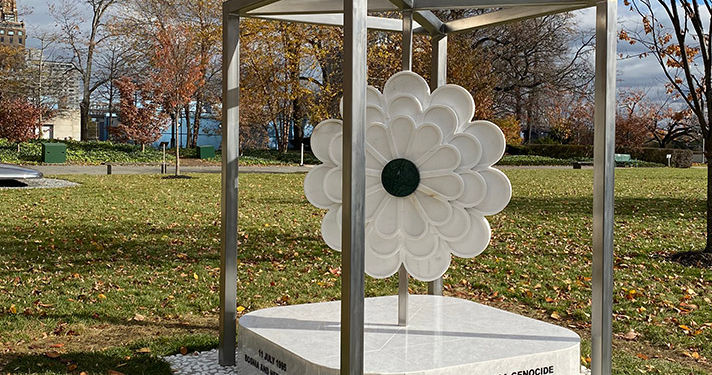
Creating a space where history, writing, and human experience come together.
The Geography of Abandonment
The Srebrenica Genocide
Introduction
In July 1995, the town of Srebrenica became the site of the only massacre during the Bosnian War legally recognized as genocide. Forces of the Bosnian Serb Army systematically executed more than 8,000 Bosniak men and boys under the command of Ratko Mladić after the fall of a United Nations-declared safe area. Dutch peacekeepers stationed in the enclave were unable to prevent the takeover. This study examines the genocide at Srebrenica through its historical context, the escalation of violence during the Bosnian War, and the mechanisms through which ethnic cleansing developed into genocidal violence. Using genocide studies frameworks such as Raphael Lemkin's definition of genocide and Gregory Stanton's staged model, the report analyzes how political polarization, territorial ambitions, and organized violence culminated in the events of July 1995. Survivor testimony and memorialization efforts further illustrate the long-term consequences of the genocide and the ongoing struggle against denial.
Historical Context
Before the Fall
Before it became synonymous with genocide, Srebrenica was a small town tucked into the hills of eastern Bosnia. The Drina River shaped the valleys surrounding the town, and Bosniaks, Serbs, and Croats lived there in uneasy but ordinary coexistence. As Noel Malcolm reminds us in Bosnia: A Short History, Bosnia's multiethnic character was not an anomaly but a historical constant. For centuries, identities overlapped more than they divided. The idea that conflict was inevitable is a nationalist myth constructed later. When Yugoslavia began to collapse in the early 1990s, the fragile political structure that held Bosnia together gave way to fear. Steven Burg and Paul Shoup argue that nationalist leaders exploited economic instability and political uncertainty to mobilize ethnic loyalty over civic belonging. In 1944, genocide scholar Raphael Lemkin defined genocide as the coordinated destruction of the foundations of group life. It does not begin with killing, but with the redefinition of who belongs. Neighbors became categories and those categories soon became targets. In Gregory Stanton's framework, these were the early stages of genocide: classification, polarization, and dehumanization.
Chronology of Events
The Slow Construction of Violence
Genocide rarely begins with killing. Norman Cigar demonstrates that what unfolded across Bosnia between 1992 and 1995 was systematic and organized. Entire towns, such as Prijedor, Foča, Višegrad, and Zvornik, were subjected to expulsion campaigns aimed at permanently altering their demographic composition. Mosques were destroyed, civilians were detained, women were assaulted, and families were forced onto buses and told never to return. This was ethnic cleansing, a violent territorial engineering. Martin Shaw argues that modern genocidal violence often occurs within war but targets civilians as a strategy of political restructuring. In Bosnia, the war became a vehicle for demographic redesign. However, as international courts later ruled, not all ethnic cleansing meets the legal threshold of genocide. The difference lies in intent. Ethnic cleansing seeks removal, whereas genocide seeks destruction. In eastern Bosnia, that distinction would collapse.
The Enclave
By 1993, Srebrenica had become a UN-declared "safe area." Thousands of displaced Bosniaks crowded into the town, believing the blue helmets of peacekeepers meant protection. They were wrong. In July 1995, forces commanded by Ratko Mladić entered the enclave. Dutch UN troops, lightly armed and restricted by mandate, were unable to stop the advance. Men and boys were separated from the women and children. That separation was not incidental but strategic. Over the next several days, more than 8,000 Bosniak males were executed. Bodies were buried in mass graves, later exhumed and reburied in secondary sites to conceal evidence. The International Criminal Tribunal for the former Yugoslavia determined that these killings were committed with the specific intent to destroy a part of the Bosniak population. The International Court of Justice affirmed the ruling. Srebrenica became the only massacre of the Bosnian War legally recognized as genocide. Here, Lemkin's definition meets the standards of legal precision. The destruction of men and boys was calculated to eliminate the reproductive and communal future of the group in that region. This was not battlefield chaos; it was targeted annihilation.
Perpetrators and Victims
The primary perpetrators of the Srebrenica genocide were units of the Bosnian Serb Army (VRS) operating under the political leadership of Radovan Karadžić and the military command of Ratko Mladić. These forces pursued a broader strategy of territorial consolidation by removing Bosniak populations from eastern Bosnia. The victims were primarily Bosniak civilians from Srebrenica and the surrounding areas. Men and boys were deliberately targeted for execution, while women, children, and elderly individuals were forcibly expelled from the region. This gender-specific targeting was significant. By eliminating the male population capable of rebuilding family and community structures, the perpetrators sought to destroy the long-term continuity of the Bosniak population in eastern Bosnia.
Violence and Erasure
Gendered Genocide: Women Who Survived
Genocide is often imagined through numbers. However, numbers conceal the architecture of grief. Selma Leydesdorff's Surviving the Bosnian Genocide: The Women of Srebrenica Speak shifts the lens. The genocide did not end with the executions. It continued in the absence. Women returned to empty homes. They searched for bones in mass graves. They buried their sons and husbands years after they were killed. Genocide scholars note that perpetrators often execute men while expelling women. Killing the men fractures the lineage and defense capacity; displacing women ensures demographic transformation. In Srebrenica, the killing of men and the forced removal of women were complementary acts within a single strategy. The genocide was not only about death but it also about erasure.
International and Domestic Responses
International Failure
Srebrenica was not hidden. Reports of ethnic cleansing and mass violence in Bosnia had already been widely documented by journalists, humanitarian organizations, and United Nations investigators before 1995, meaning the international community was aware of the risks facing vulnerable populations such as those in Srebrenica. Dutch peacekeepers were stationed there, NATO had the capacity for intervention, and the world was aware. Nevertheless, air support came too late, and political hesitation outweighed protection. This exposes a structural weakness in genocide prevention theory: recognition does not guarantee action. Fifty years after "Never Again," genocide unfolded in Europe. Srebrenica reveals the limits of international mandates, the fragmented nature of political will, and the prioritization of sovereignty over civilian protection. The genocide demonstrates how awareness of atrocity does not always translate into effective intervention.
Legal and Theoretical Analysis
Justice and Its Limits
Both Radovan Karadžić and Ratko Mladić were convicted of genocide. Trials established a historical record. Mass graves were mapped, forensic science identified remains, and some families were able to reclaim and bury their lost relatives. Yet justice remains incomplete. Genocide denial persists in parts of Bosnia and Serbia. Political leaders continue to dispute the term, and memorialization itself has become contested. The law can define genocide, but it cannot make everyone believe it occurred, nor can it restore the dead. Although widespread ethnic cleansing and mass violence occurred across Bosnia during the war, international courts determined that only the killings at Srebrenica met the legal threshold of genocide. The rulings emphasized that the executions demonstrated a specific intent to destroy a substantial part of the Bosniak population in eastern Bosnia. By targeting men and boys capable of sustaining the community's future, the perpetrators sought to eliminate the possibility of the Bosniak population reconstituting itself in the region.
Survivor Testimonies & Memory
The Drina's Memory
In Bosnia in Limbo: Testimonies from the Drina River, Borja Lasheras and James Badcock describe a region suspended between acknowledgment and denial. The Drina River once marked shared geography. During the war, it became a corridor of violence. Today, it marks a political fracture. Denial is not an afterthought. In Stanton's final stage of genocide, denial completes the process. Memory becomes resistance. Survivor testimony continues to shape how the genocide at Srebrenica is remembered and understood. The documentary The Srebrenica Genocide: A Bosnian Woman's Search for Her Missing Brother follows the story of a woman still searching for the remains of her brother decades after the massacre. Her account illustrates how the violence of July 1995 did not end with the executions but continues to affect families who are still trying to recover the remains of loved ones and piece together what happened. The documentary highlights the emotional and psychological toll of genocide, demonstrating how the search for missing relatives has become an enduring part of the survivors' lives. These narratives reinforce the importance of memory and testimony in preserving the historical record of the genocide and resisting denial. The Srebrenica Memorial Center's oral history archive preserves survivor testimony. The USC Shoah Foundation's Bosnia-Herzegovina collection documents thousands of hours of survivor accounts.
Survivor Testimony
Survivor testimony also provides a deeply personal understanding of the events surrounding the fall of Srebrenica. In Voices from Srebrenica, Hasan Hasanović recalls the chaos and fear that spread through the town as Bosnian Serb forces advanced. Reflecting on the moment when families were separated, he writes that people were "crying, calling out to one another, and trying to stay together, but the soldiers pushed the men away from their families." Accounts such as these reveal the human dimension behind the historical record. Survivors describe the sudden rupture of family life, the fear and uncertainty that followed the takeover of the enclave, and the lasting trauma of losing fathers, brothers, and sons.
These experiences are not limited to Srebrenica itself but are reflected across Bosnia. Bajazit Kargić, who was eleven years old when the war began in 1992 and lived in central Bosnia, describes a similar pattern in which violence did not arrive all at once, but developed gradually. He recalls that “life did not immediately turn into constant gunfire,” but instead through increased restrictions, growing fear, and limited access to supplies. His account reflects the early stages of genocidal processes identified by scholars, where tension and division become normalized before escalating into mass violence. Kargić also emphasizes the psychological impact of war, particularly the uncertainty that defines daily life. He describes watching adults carry fear while attempting to shield children from its full weight and recalls that the most lasting impression was “not knowing what tomorrow would bring.” These experiences illustrate how instability and insecurity shape civilian life during conflict and force rapid emotional and psychological maturation.
Importantly, he underscores that the violence in Bosnia was not spontaneous. Reflecting on the events, he states that the war involved “organized ethnic cleansing and genocide,” and that these processes began with division and dehumanization rather than immediate mass killings. His perspective shows that genocide is not a single event, but a process that unfolds over time and is experienced at the individual level. Survivor memory, however, does not remain confined to the past. It continues to shape how individuals interpret violence today. This is reflected in a poem by Kargić, in which he connects his lived experience of war to contemporary suffering. He writes:
This is murder dressed in excuses,
this is theft of life,
this is a shadow on humanity itself.
In another line, he writes, “I write with blood in my memory” (pišem s krvlju u sjećanju),
capturing the enduring imprint of violence on identity and perception.
These expressions demonstrate how survivor testimony extends beyond recollection into moral witness. The language of the poem reflects the same patterns identified in genocide studies: the recognition of organized violence, the rejection of its justification, and the insistence on human accountability. In this way, survivor narratives do not replace theoretical analysis but deepen it. They illuminate the early stages of discrimination and polarization, revealing how ethnic cleansing functions and the intergenerational consequences of genocide. At the same time, these testimonies reflect the ongoing struggle for justice and recognition, highlighting the limits of international accountability and the importance of preserving memory.
Conclusion
The Meaning of Srebrenica
Srebrenica stands as both a legal precedent and a moral rupture. It demonstrates that genocide does not erupt spontaneously. It is cultivated through propaganda, bureaucratic organization, militarization, and international hesitation. It also demonstrates that survival resists erasure. The women of Srebrenica speak. The Drina remembers. The graves testify. Survivor testimonies, including the stories documented in films such as The Srebrenica Genocide: A Bosnian Woman's Search for Her Missing Brother, remind us that the consequences of genocide continue long after the violence ends, as families still search for the remains of loved ones and struggle to preserve the truth of what happened. The task of scholarship is not only to document atrocity but to guard memory against denial. Srebrenica was an attempt to erase a community from Bosnia. The continued act of remembering and preserving testimony ensures that the truth of what happened cannot be erased.
Bibliography
Becirovic, Mevlija. “Oral History.” Srebrenica Memorial Center. August 22, 2025. https://srebrenicamemorial.org/en/investigations/oral-history/33.
Burg, Steven L., and Paul S. Shoup. The War in Bosnia-Herzegovina: Ethnic Conflict and International Intervention. Armonk, NY: M.E. Sharpe, 1999.
Cigar, Norman L. Genocide in Bosnia: The Policy of “Ethnic Cleansing.” College Station, TX: Texas A&M University Press, 1995.
International Court of Justice. Bosnia and Herzegovina v. Serbia and Montenegro. Judgment, February 26, 2007. https://www.icj-cij.org/node/103164.
International Criminal Tribunal for the Former Yugoslavia. Prosecutor v. Radislav Krstić. Case No. IT-98-33-A. Judgment. https://www.icty.org/en/case/krstic.
International Criminal Tribunal for the Former Yugoslavia. Prosecutor v. Radovan Karadžić. Case No. IT-95-5/18-T. Judgment, March 24, 2016. https://www.icty.org/x/cases/karadzic/tjug/en/160324_judgement.pdf.
Kargić, Bajazit. Interview and unpublished poem provided to author. March 2026.
Lasheras, Borja, and James Badcock. Bosnia in Limbo: Testimonies from the Drina River. Stuttgart: Ibidem-Verlag, 2018.
Lemkin, Raphael. Axis Rule in Occupied Europe: Laws of Occupation, Analysis of Government, Proposals for Redress. Washington, DC: Carnegie Endowment for International Peace, 1944. https://archive.org/details/axisruleinoccupi0000lemk.
Leydesdorff, Selma. Surviving the Bosnian Genocide: The Women of Srebrenica Speak. Translated by Kay Richardson. Bloomington: Indiana University Press, 2011.
Malcolm, Noel. Bosnia: A Short History. New York: New York University Press, 1996.
Petrila, Ann, Hasan Hasanović, and Emir Suljagić. Voices from Srebrenica: Survivor Narratives of the Bosnian Genocide. Jefferson, NC: McFarland, 2021.
Power, Samantha. “A Problem from Hell”: America and the Age of Genocide. New York: Basic Books, 2002.
Shaw, Martin. What Is Genocide? Malden, MA: Polity Press, 2015.
Sole, Albert, ed. Srebrenica: The Last Tape. YouTube video. Accessed March 15, 2026. https://www.youtube.com/watch?v=oosmgI3fMrc.
Stanton, Gregory H. “The Ten Stages of Genocide.” Genocide Watch. Accessed March 3, 2026. https://www.genocidewatch.com/tenstages.
USC Shoah Foundation. “War and Genocide in Bosnia-Herzegovina Collection.” Accessed March 9, 2026. https://sfi.usc.edu/collections/bosnia-herzegovina
Noel Malcolm, Bosnia: A Short History (New York: New York University Press, 1996), 212–215.
Steven L. Burg and Paul S. Shoup, The War in Bosnia-Herzegovina: Ethnic Conflict and International Intervention (Armonk, NY: M.E. Sharpe, 1999), 34–35.
Raphael Lemkin, Axis Rule in Occupied Europe: Laws of Occupation, Analysis of Government, Proposals for Redress (Washington, DC: Carnegie Endowment for International Peace, 1944), 79.
Gregory H. Stanton, “The Ten Stages of Genocide,” Genocide Watch, accessed March 3, 2026, https://www.genocidewatch.com/tenstages.
Norman L. Cigar, Genocide in Bosnia: The Policy of “Ethnic Cleansing” (College Station, TX: Texas A&M University Press, 1995), 45–60.
Martin Shaw, What Is Genocide? (Malden, MA: Polity Press, 2015), 112–118
Burg and Shoup, The War in Bosnia-Herzegovina, 280–285.
International Criminal Tribunal for the Former Yugoslavia, Prosecutor v. Radislav Krstić, Case No. IT-98-33-A, Judgment, August 2, 2001.
International Court of Justice, Bosnia and Herzegovina v. Serbia and Montenegro, Judgment, February 26, 2007.
Selma Leydesdorff, Surviving the Bosnian Genocide: The Women of Srebrenica Speak, trans. Kay Richardson (Bloomington: Indiana University Press, 2011), 101–115.
Samantha Power, “A Problem from Hell”: America and the Age of Genocide (New York: Basic Books, 2002), 247–275.
Stanton, “The Ten Stages of Genocide.”
International Criminal Tribunal for the Former Yugoslavia, Prosecutor v. Radovan Karadžić, Case No. IT-95-5/18-T, Judgment, March 24, 2016.
Borja Lasheras and James Badcock, Bosnia in Limbo: Testimonies from the Drina River (Stuttgart: Ibidem-Verlag, 2018), 88–102.
Stanton, “The Ten Stages of Genocide.”
Mevlija Bećirović, “Oral History,” Srebrenica Memorial Center, August 22, 2025, https://srebrenicamemorial.org/en/investigations/oral-history/33.
USC Shoah Foundation, “War and Genocide in Bosnia-Herzegovina Collection,” accessed March 9, 2026, https://sfi.usc.edu/collections/bosnia-herzegovina
Ann Petrila, Hasan Hasanović, and Emir Suljagić, Voices from Srebrenica: Survivor Narratives of the Bosnian Genocide (Jefferson, NC: McFarland, 2021), 74.
Bajazit Kargić, interview by Tonya Sidelinger, March 2026.
Kargić, interview.
Kargić, interview.
Bajazit Kargić, poem shared with author, March 2026.
Sole, Albert, ed. Srebrenica: The Last Tape. YouTube video. Accessed March 15, 2026.